Tutorial
GenML is a Python library designed for generating Mittag-Leffler correlated noise, widely used in modeling complex systems. This notebook demonstrates the basic functionalities of GenML, including generating noise sequences and calculating their autocorrelation functions.
Importation and Parameters
First, get started by having all the necessary tools and libraries imported.
import numpy as np
import genml
from matplotlib import pyplot as plt
Before diving into the noise generation, it’s essential to set up some fundamental parameters that define the properties of the noise we intend to generate, such as the number of sequences, length of each sequence, amplitude coefficient, and others.
# Parameters
N = 500  # Number of sequences
T = 1000  # Length of each sequence
C = 1.0  # Amplitude coefficient
lamda = 1.8  # Mittag-Leffler exponent
tau = 10  # Characteristic memory time
seed = None # Random seed

nc = 4  # Number of CPU cores for parallel processing
tmax = 200  # Max lag for ACF calculation
dt = 1  # Step size between lags
Generating Mittag-Leffler Correlated Noise
In this section, we utilize GenML to generate Mittag-Leffler correlated noise sequences. The mln function from the GenML library is called with specified parameters to produce the desired noise sequences.
# Generate M-L noise sequences
xi = genml.mln(N, T, C, lamda, tau, seed)
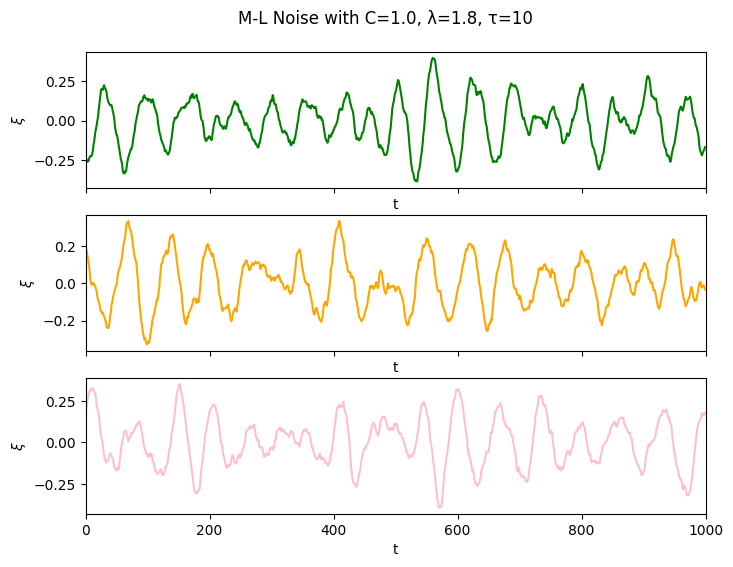
Visualization of Mittag-Leffler Correlated Noise
After generating the Mittag-Leffler noise sequences, we’ll visualize them using matplotlib to observe the characteristics of each sequence.
fig, axs = plt.subplots(3, 1, figsize=(8, 6), sharex=True)
colors = ['green', 'orange', 'pink']

for i, noise in enumerate(xi[:3, :]):
    axs[i].plot(range(T), noise, color=colors[i])
    axs[i].set_xlim(0, T)
    axs[i].set_ylabel('$\\xi$')
    axs[i].set_xlabel('t')

fig.suptitle(f'M-L Noise with C={C}, λ={lamda}, τ={tau}', y=0.95)

plt.show()
Calculating Autocorrelation Functions
Autocorrelation functions (ACF) are crucial for understanding the properties of generated noise sequences. Here we calculate both the actual ACF values from the generated sequences and the theoretical ACF values using GenML’s acf and acft functions, respectively.
# Calculate actual ACF values
acfv = genml.acf(xi, tmax, dt, nc)

# Calculate theoretical ACF values
acftv = genml.acft(tmax, dt, C, lamda, tau)
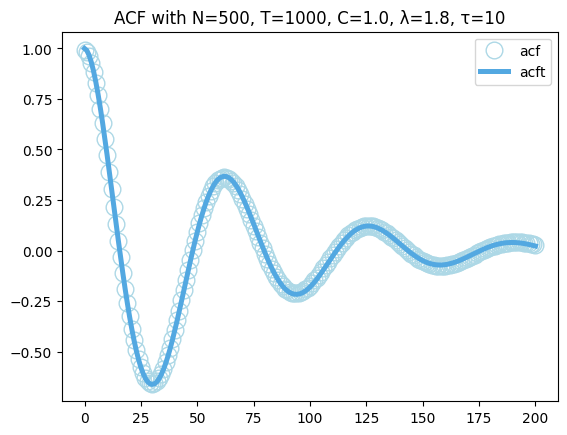
Visualization of ACF Results
Visualizing the autocorrelation functions helps in comparing the actual and theoretical ACF values, providing insights into the accuracy and effectiveness of the GenML library in simulating Mittag-Leffler correlated noise.
t = list(range(0, tmax + 1, dt))

plt.plot(t, acfv*tau**lamda/C, 'o', label='acf', color='lightblue', markerfacecolor='none', markersize=12)
plt.plot(t, acftv*tau**lamda/C, label='acft', color='#53A8E1', linewidth=3.6)
plt.legend()

plt.title(f'ACF with N={N}, T={T}, C={C}, λ={lamda}, τ={tau}')
plt.show()
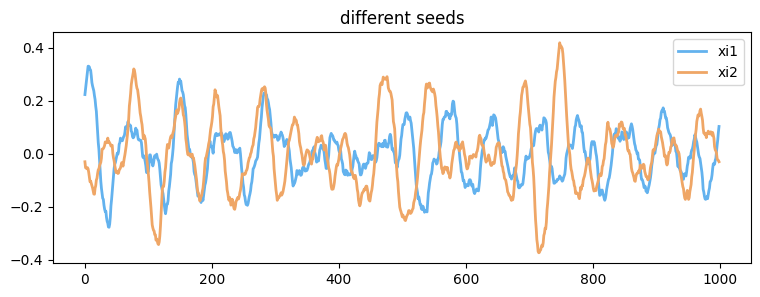
Validating Seed Effect
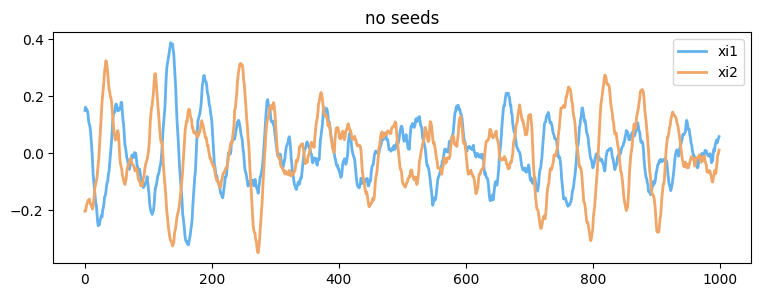
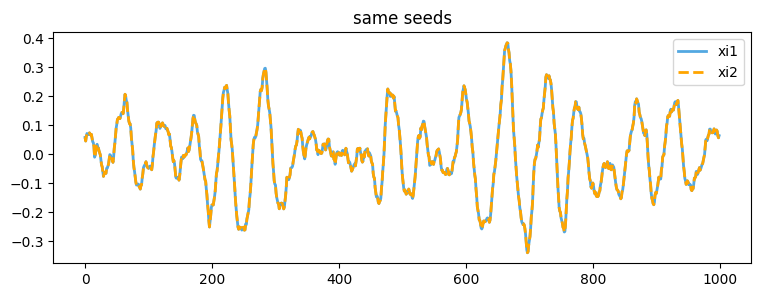
The following codes demonstrate the effect of setting a seed value on the generation of random noise sequences. When the seed is a specific value, each call to generate noise sequences with the same seed will result in identical sequences. When the seed is set to None, different runs will produce different noise sequences.
Same Seeds
# Generate noise sequences with seed set to 42
xi1 = genml.mln(N, T, C, lamda, tau, seed=42)
xi2 = genml.mln(N, T, C, lamda, tau, seed=42)

# Check if the generated noise sequences are equal
is_equal = np.array_equal(xi1, xi2)
is_equal
t = list(range(0, T))
plt.figure(figsize=(9, 3))
plt.plot(t, xi1[0, :], '-', label='xi1', color='#53A8E1', linewidth=2)
plt.plot(t, xi2[0, :], '--', label='xi2', color='orange', linewidth=2)
plt.legend()

plt.title(f'same seeds')
plt.show()
Different Seeds
# Generate noise sequences with seed set to different seeds
xi1 = genml.mln(N, T, C, lamda, tau, seed=666)
xi2 = genml.mln(N, T, C, lamda, tau, seed=888)

# Check if the generated noise sequences are equal
is_equal = np.array_equal(xi1, xi2)
is_equal
t = list(range(0, T))
plt.figure(figsize=(9, 3))
plt.plot(t, xi1[0, :], '-', label='xi1', color='#63b2ee', linewidth=2)
plt.plot(t, xi2[0, :], '-', label='xi2', color='#efa666', linewidth=2)
plt.legend()

plt.title(f'different seeds')
plt.show()
No Seeds
# Generate noise sequences with no seeds
xi1 = genml.mln(N, T, C, lamda, tau, seed=None)
xi2 = genml.mln(N, T, C, lamda, tau, seed=None)

# Check if the generated noise sequences are equal
is_equal = np.array_equal(xi1, xi2)
is_equal
t = list(range(0, T))
plt.figure(figsize=(9, 3))
plt.plot(t, xi1[0, :], '-', label='xi1', color='#63b2ee', linewidth=2)
plt.plot(t, xi2[0, :], '-', label='xi2', color='#efa666', linewidth=2)
plt.legend()

plt.title(f'no seeds')
plt.show()